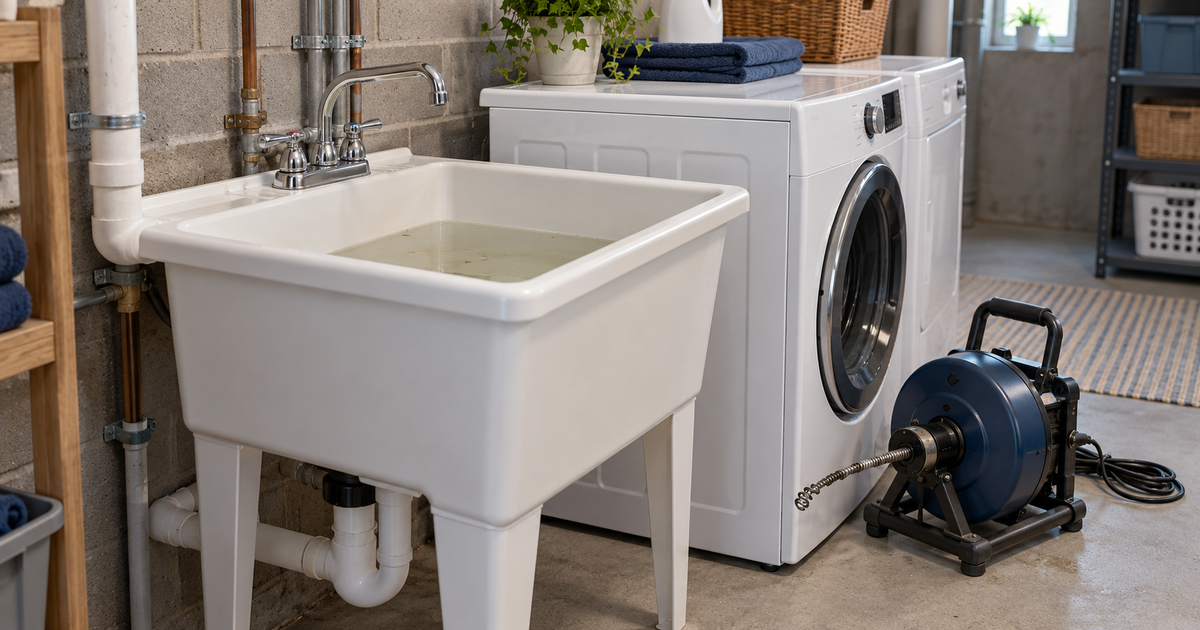
A laundry sink backup that appears when kitchen or laundry fixtures drain can point to a restriction along a connected drain route. The place where water emerges does not necessarily identify where the obstruction sits. Pipe layout and access also affect how a plumber can reach the problem.
An ACCU Plumbing service visit in Blue Springs, Missouri, illustrates this. A kitchen and laundry drain line backed up through a basement laundry sink. The first cleaning approach did not clear it. Accessing the line from downstairs allowed the technician to make multiple passes and restore drainage during testing.
For homeowners, this case explains why clearing a drain may require a change in approach rather than repeated attempts from the same opening.
Why a laundry sink backup needs context
A drain backup means wastewater is not moving away as expected and is appearing where it should not. A laundry sink may be the visible location even when the problem involves a connected section serving other fixtures.
That does not make every laundry backup a main-sewer problem. It also does not establish that the utility sink itself is defective.
The useful questions concern the pattern: which fixture was used, where water appeared, whether other drains were affected, and whether the issue has happened before.
Avoid assuming the layout from the rooms alone. A plumber needs to assess the actual piping and available access before deciding where to work.
The Blue Springs case involved a kitchen/laundry line, but its findings cannot establish the arrangement of another home’s drains.
What happened during the Blue Springs visit
The work record describes water backing up through the basement laundry sink. The technician first attempted to snake the line from beneath the kitchen sink.
That approach was unsuccessful. The record lists two possibilities: grease narrowing the pipe or a bend too tight for that approach.
Neither possibility was confirmed as the cause. It would therefore be inaccurate to describe this as a proven grease blockage or a confirmed defective pipe bend. The technician then accessed the line from downstairs and made multiple passes. The blockage cleared.
Afterward, hot water ran for more than ten minutes without another backup during testing. That is a documented completion result, not a promise that the line would remain clear permanently.
Why the access point can change the work
A drain-cleaning access point is the location from which a technician enters the piping with appropriate equipment. The most obvious fixture opening is not always the most effective route.
The available route affects how equipment reaches the relevant section. In this case, the initial approach did not resolve the blockage, while the downstairs approach allowed further work.
That is a practical example of adapting to conditions. It does not establish that downstairs access is always better or that every unsuccessful attempt indicates damaged piping.
A homeowner can ask why the provider recommends a particular opening and whether another access route is available. The answer should relate to the actual installation.
Avoid opening caps, dismantling pipes, or trying to locate a blockage by taking the drainage system apart. Access decisions belong within the assessment and proposed work.
Why multiple passes may be part of cleaning
The Blue Springs record specifically documents multiple passes after the technician changed access. One pass was not the entire service.
The number of passes alone does not tell you whether a blockage was minor, severe, or fully diagnosed. It describes part of the method used on that visit.
More useful questions are whether drainage improved, what was observed, and how operation was checked afterward.
An understandable service explanation distinguishes clearing an obstruction from proving the long-term condition of the entire pipe. Restored flow can be a meaningful result without answering every question about the drainage system.
If backups return, the previous work remains relevant history. It should inform the next assessment without replacing it.
Ask the provider what symptoms would justify further investigation and what that investigation would seek to establish.
What to do when water backs up
Stop using the fixtures or appliances associated with the backup. Repeatedly sending water into an affected line can add to the immediate problem.
Keep children and pets away from the affected area and avoid contact with backed-up wastewater. Do not assume that water is harmless because it appeared in a laundry sink.
From a safe, dry position, note where the water appeared and what had been running beforehand. You do not need to reproduce the backup to provide a useful description.
Tell the service provider whether any chemical drain products have already been used. Keep the product name available.
Poison Control explains that many drain cleaners contain corrosive chemicals. Avoid adding products to an active backup or improvising combinations in an attempt to speed up drainage.
If the area is unsafe to approach, leave the equipment and fixtures alone and describe the situation when arranging help.
Details that help a plumber assess the complaint
The most helpful information is a sequence of observations rather than a diagnosis guessed from an online search.
Record what you can safely observe:
Which fixture or appliance was operating.
Where the backed-up water appeared.
Whether the water eventually drained away.
Whether another fixture was also affected.
Whether the same pattern has happened before.
Any prior cleaning, repairs, or products used.
For example, saying that the basement utility sink rises when the kitchen drains is more specific than saying every drain is blocked.
If the problem is intermittent, explain how often you have noticed it. Do not deliberately run a full sink or appliance cycle to prove it happens.
A photo of existing conditions may help, provided it can be taken safely and shared without unnecessary personal information.
Grease prevention without assuming the cause
Grease was one possibility in this case, but it was not a confirmed diagnosis. General prevention advice should preserve that distinction.
The Texas Commission on Environmental Quality explains that fats, oils, and grease can accumulate inside sewer pipes and restrict flow.
Keeping cooking grease out of drains is therefore a useful household practice. It does not prove that grease caused a particular backup or that changing disposal habits will repair an existing obstruction.
Ask ACCU Plumbing for maintenance guidance suited to the home’s piping and service findings. Do not assume that a product labeled natural is appropriate for every system. The case packet includes an unspecified drain-cleaner reference, but no verified product or safe application method.
When recurring backups need another assessment
A recurrence is useful information. Record whether it involves the same fixtures, the same trigger, and a similar amount of water.
Tell the provider how long drainage appeared normal after the previous service. A brief improvement and a long symptom-free period are different histories.
Ask what further assessment would clarify. Depending on the findings, the next conversation may involve cleaning, inspection, access, or pipe condition. None should be presented as automatically necessary from this case alone.
For broader warning signs, ACCU Plumbing’s guide to drains that need professional cleaning provides related context. This case focuses specifically on the relationship between a backup, the working access, and completion testing.
Ask what the test demonstrated
A useful completion discussion identifies what water was run, what the technician observed, and which fixtures were checked. It also distinguishes those observations from a comprehensive condition assessment of every connected pipe.
In the recorded job, more than ten minutes of hot-water testing produced no further backup. That supports the stated completion result. Keep that distinction in the service record. If the problem returns, the next provider can use the earlier findings without inheriting conclusions the record never supported.
Frequently asked questions
Does a laundry sink backup mean the sink needs replacement?
Not necessarily. The Blue Springs example involved a drain-line blockage that was cleared without a recorded sink replacement.
Does one unsuccessful snaking attempt prove the pipe is broken?
No. The initial attempt in this case was unsuccessful, but another access route allowed the blockage to be cleared. The record does not establish broken piping.
Was grease definitely responsible?
No. Grease narrowing the pipe and a tight bend were recorded as possibilities. Neither was confirmed.
Does successful flow testing guarantee the backup will never return?
No. It establishes how the system behaved during the documented test. Future recurrence requires its own assessment.
Arrange drain cleaning in Blue Springs
A laundry sink backup deserves an explanation that considers the connected fixtures and available access. The Blue Springs case shows why the right approach may change as the technician learns more.
For drain cleaning in Blue Springs, Missouri, contact ACCU Plumbing and describe the backup pattern. Same-day appointments may be available; call to check.